







Natural Ecology Resources
ㅡ
Solti Moonlight Eco-Forest
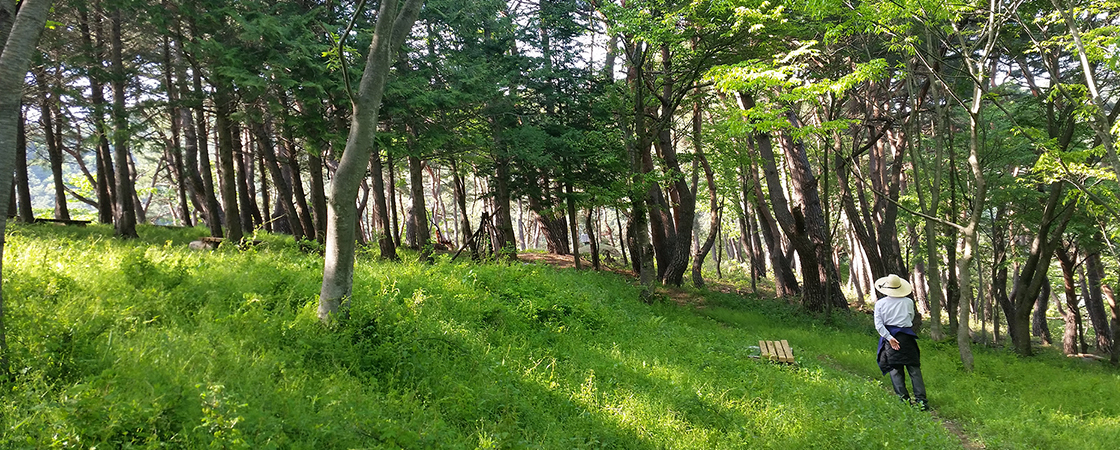
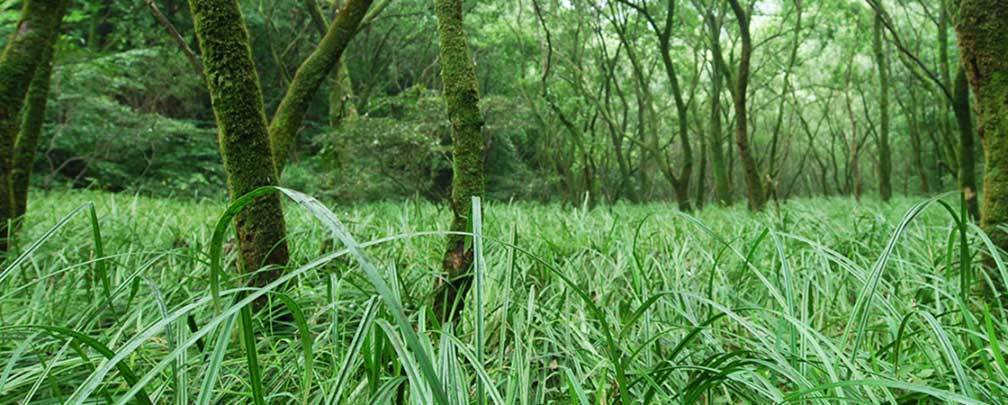
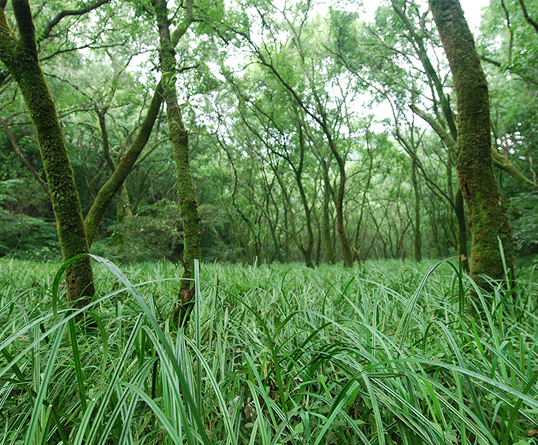
Naejangsan means ‘many treasures are hidden in mountain’ due to the gorgeous beauty of nine peaks like Geumseon fall and valley, Seolaebong and Kkachibong peaks. These beautiful sceneries are reasons why Naejangsan mountain is called Geumgangsan (known to be the most graceful moutain in Korea) of Honam area. This eco-forest is the place where you can enjoy the nature of Solti town (where it was designated as a part of National park until 2010), Apdorang (habitat of fireflies), and the ecological resources of Wolyoung swamp altogether. The Wolyoung swamp is located at an altitude of 300 meters. It is near the top of mountains where the ground is comparably flat. This inland swamp was formally used as farmland, however, it was abandoned forty years ago, and is regaining its original form with ecological succession.
- Address
- Jeollabuk-do Province Jeongeup-si Songjuk-gil 25
- Inquiry
- 063-539-5703 (Environment Division, Jeongeup-si)
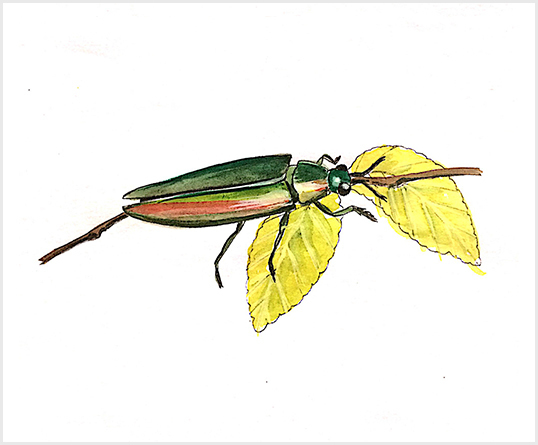
Buprestid
Ranked second class of endangered species and natural monument no.496, Buprestid grows up to four centimeters and categorized as large-type among other beetles. Buprestid is a beautiful large insect which have red and blue gloss on gold green base color. They inhabit in warm area and Casterpillar are all arounds like Naejangsan mountain or south of the center in Korea. You can see Imago in July to August, but it is difficult to find because population number is very small and habitat is limited. Recently Buprestid in Korea is known for worldwide new species because it is an indigenous species that have different DNA structures from Japan and China’s buprestid.
Experience Program
ㅡ
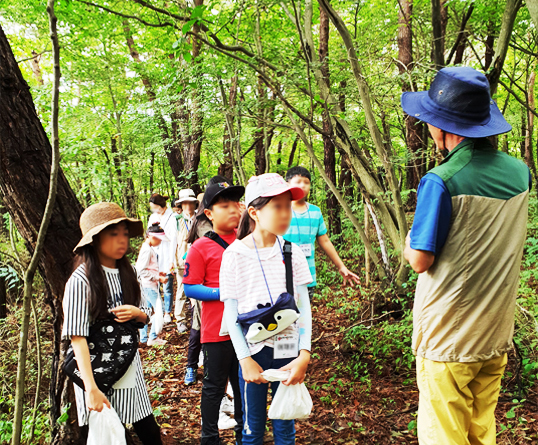
Botanic Expedition
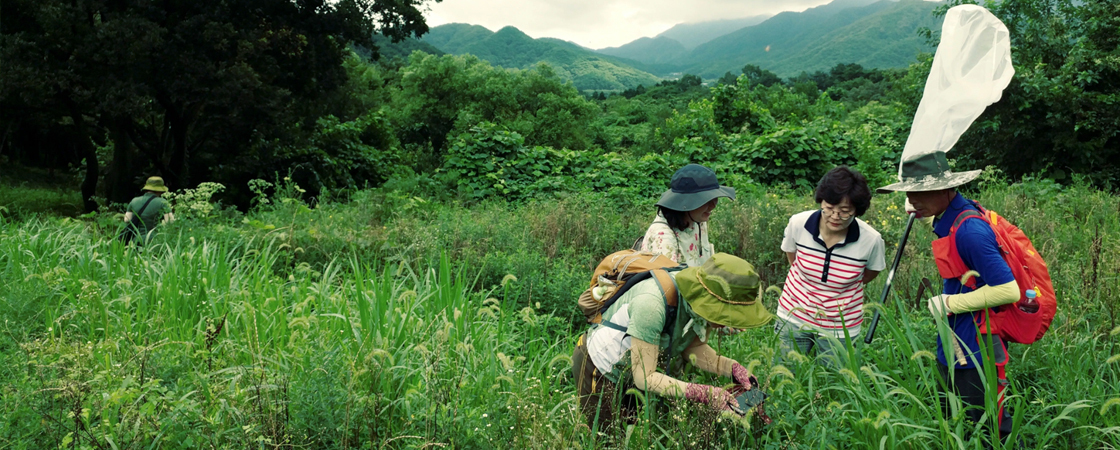
Explore ecology of Solti Forest and Woryeong Wetland and learn about chronicle of plants and earth environment preservation
- Target : Children and teenagers (minimum number of people : 10)
- Operation Time : March ~ December (10 times a month)
- Time Required : 30 minutes ~ 2 hours
- Participation Fee
- Free
- Inquiry
- ☎ 010-8786-5021 (Eco Manager)
- ☎ 063-539-5703 (Environment Division, Jeongeup-si)
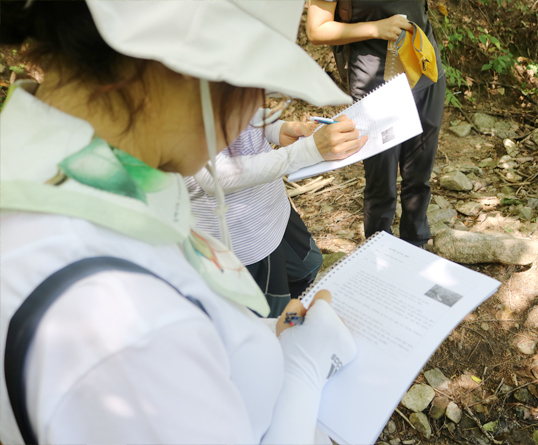
Eco-Budding
Learn about birds living in mountains and water of Solti Forest and Woryeong Wetland and hear explanation on history of Solti Village
- Target : All ages (minimum number of people : 10)
- Operation Time : March ~ December (10 times a month)
- Time Required : 30 minutes ~ 2 hours
- Participation Fee
- Free
- Inquiry
- ☎ 010-8786-5021 (Eco Manager)
- ☎ 063-539-5703 (Environment Division, Jeongeup-si)
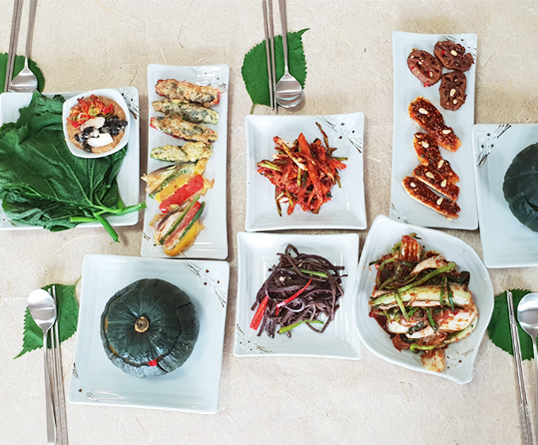
Ecological Dining Table
Collect ramie leaf, make rice cakes, and experience ecological dining table full of specialties of the village.
- Target : All ages (minimum number of people : 15)
- Operation Time : March ~ December (10 times a month)
- Time Required : 1 hour
- Participation Fee
- 10,000 won
- Inquiry
- ☎ 010-8786-5021 (Eco Manager)
- ☎ 063-539-5703 (Environment Division, Jeongeup-si)
Historical Culture Resource
ㅡ
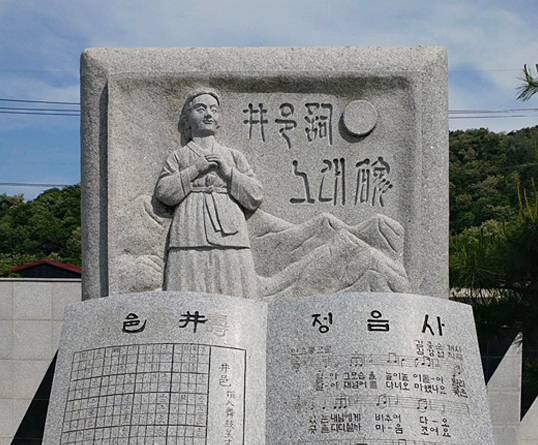
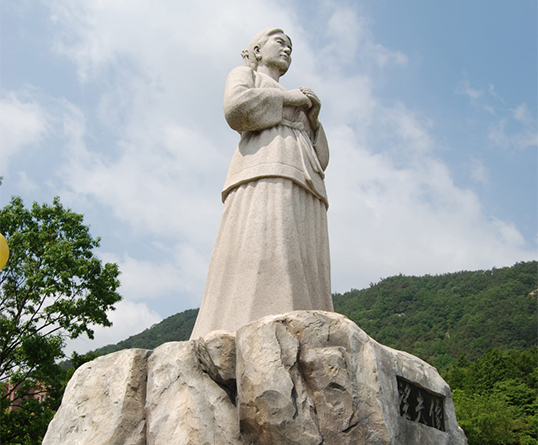
Jeongeupsa Park Fostered in where Baekje Gayo Jeongeupsa temple was builted. In site of Jeongeupsa, 67,000 pyeong scale of park was built and Baekje’s statue of widow (Mangbusang), symbol of the city, and Jeongeupsa music stone was constructed.
- Address
- Jeollabuk-do Province Jeongeup-si Jeongeupsa-ro 541
- Inquiry
- 063-539-5771
Lodging
ㅡ
- Naejangsan Path Private Residence
- Jeollabuk-do Jeongeup-si Wolyoung-2gil 11-34
063-536-5646 - Naejang Scenery Pension
- Jeollabuk-do Jeongeup-si Naejangsan-ro 620-4
010-2606-6715 - Solhyanggi Pension
- Jeollabuk-do Jeongeup-si Cheomdangwahak-ro 770
010-9329-1900
- Naejangsan Lake Pension
- Jeollakbuk-do Jeongeup-si Churyeong-ro 2180-6
063-538-8048 - Naejangsan Naejang Campground
- Jeollabuk-do Jeongeup-si Naejang-dong 92-2
063-538-7875 - Naejangsan National Leisure Campground
- Jeollabuk-do Jeongeup-si Naejangsan-ro 390
063-538-7955
Recommended Course
ㅡ
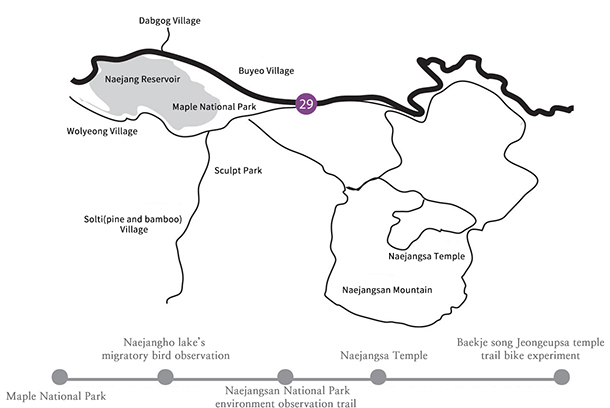
Coordinate Tourism
ㅡ
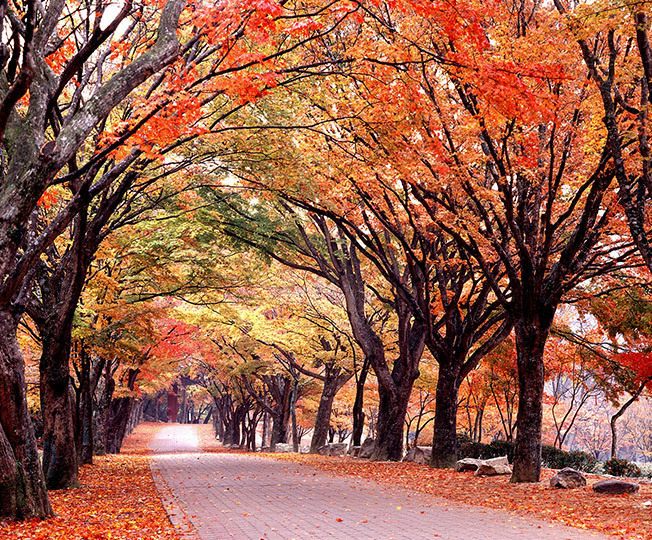
Naejangsan National Park
Called as Geumgang of Honam, Naejangsan was famous for eight grand scenery of Joseon dynasty for a long time. Also stated five famous mountains of Honam with Namwon Jirisan mountain, Yeongam Wolchulsan mountain, Jangheung Cheongwansan mountain and Buan Neunggasan mountain(Byeonsan mountain) in Donggugyeojiseunglam. Najangsan mountain’s maple forest walk way in fall is known for its beauty.
- Address
- Jeollabuk-do Province Jeongeup-si Naejangsan-ro 936
- Inquiry
- 063-538-7875
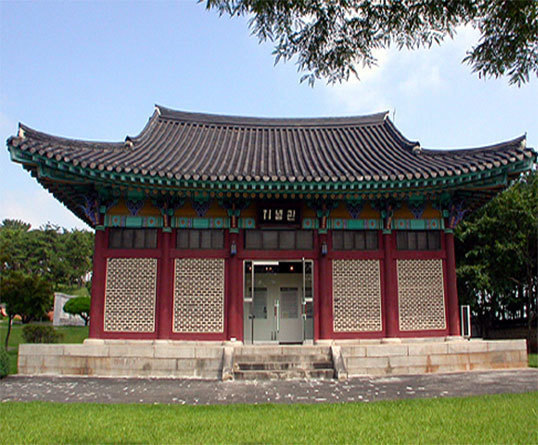
Donghak Peasant Revolution Site Memorial Hall & Hwangtohyeon Battlefield
Articles of March Uprising at Baeksan Mountain, Jeonju Jipkang Institute, September Uprising at Samnye, and Battle of Ugeumchi
The place exhibits inkstone, brush, bamboo hat, gat (Korean traditional hat), and shoes that are the only remaining articles used by the general Jeon Bong-Jun who was the leader of Donghak Peasant Revolution. Also, the place exhibits total of 185 types of 290 items including historical records (Gapo Silgi, Jeon Bong-Jun’s Trial Record, Yongdam Yoosa, Donggyeong Daejeon, Gamogun Gongrok), photos, weapons, and books that help people to better understand the time period. The memorial hall also exhibits 75 types of 131 items such as round robin and wardrobe from the house of Jeon Bong-Jun.
Hwangtohyeon Battlefield
A place where peasant troops led by general Jeon Bong-Jun first fought with the royal forces and accomplished great victory over Jeolla Provincial Office. The place enshrines the portrait of general Jeon Bong-Jun.
- Address
- Jeollabuk-do Province Jeongeup-si Donghak-ro 742
- Inquiry
- 063-536-1894
A Bio-resource Survey
ㅡ
Biological Distribution Range
Naejangsan, Maeul soop-gil, arboretum, Yeongwol wetland, wolbong wetland
Remark
There are 2 Wolyeong wetlands which are designated by the Ministry of Environment, between Solti town and Wolyeong town.
There are colonies of Naejangsan natural monument (No.911) with Daphniphyllum macropodum Miq. and Torreya nucifera.
It is a perfect place for otters, because there are Naejang reservoir and the waterways or streams are connected to village.
-
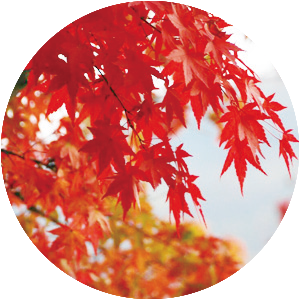
Korean maple
PlantIt is a deciduous arbor that grows in the mountains in Korea, and is also found in Northeastern China and Russia. The stalk is 10 to 20 cm. The leaves grow in opposite leaf arrangement, and their width and length are about 10cm. The bottom of the leaf is the shape of a heart. The back of the leaf has a lot of white hair. Both maple syrup in Western countries and golisoo in Korea are the sap of this sweet maple tree. The maple seed resembles a propeller, which spins round when the wind blows.
-
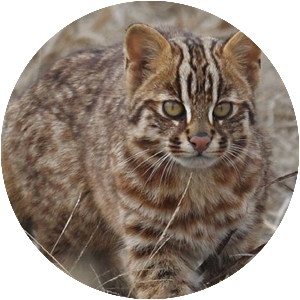
Leopard Cat
AnimalBecause a leopard cat lives on rats, it has a long body and short legs. It also eats fruits like mulberries and Siberian gooseberries, as well as insects in summer. It is active day and night. The male is twice as large as the female. Just like other Mustelidae family, it defecates long and thin feces on a rock,
-
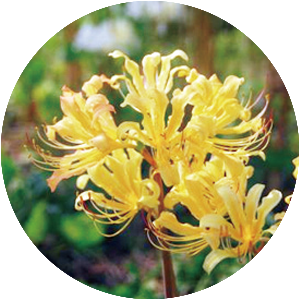
Lycoris chinensis var. sinuolata (Jinnorang sangsahwa)
PlantIt is a perennial plant that grows in clusters near a humid valley of low mountains. The green linear-shaped leaves, which are about 32.2 to 50 cm long and 1.2 to 2.5 cm wide, grow from April to May as overlapping with 3-4 leaves. A Buddhist monk fell in love with a woman who came to a temple to worship. However, he was not allow to date with the woman because he was a monk. Then he died of a lovesick. The flower bloomed on his grave resembled the monk, as the leaf withered before the flower bloom – they never grow (or meet) at the same time; so people have called this flower as Sangsahwa (roughly translating to ‘longing for someone’ in Korean).
-
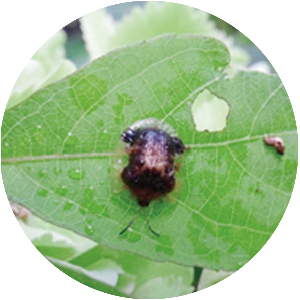
Thlaspida cribrosa
InsectThe body is 8.2 mm long and the head is 1.3 mm wide. Its reddish-brown body is flat and long oval-shaped. There are 16 pairs of bumps on a side which are covered with bristles and 1 pair of anal papilla. The spiracle and the sides of the body are dark brown. It has a unique features. The caterpillar covers itself with a cast-off skin and feces to camouflage by making itself as a big chunk. When it feels threats, it doesn’t move and pretends it is dead.
-
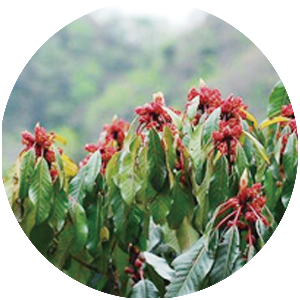
Daphniphyllum macropodum Miq.
PlantIt was originally found in the southern part of Korea; however, with the change of climate, it is also found in Mt. Naejang (Natural Monument No. 91), which is placed in northern limit line (NLL), as it moves its habitat towards the norther part. This species is also called gyoyangmok (written in Chinese characters) as well as in China and Japan. When the new leaves grow, the old leaves fall off, so that the new leaves can grow well.
-
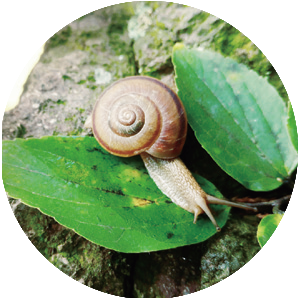
Naejangsan-ddee-dalpengi
MollusckThe shell is conical shaped which is 13mm high and 19mm wide. There are 5.5 stories of whorl. The shell epidermis is light yellow; the colors may vary depending on the distribution. Spirals are brown and incremental lines are very clear. The suture is definite. Shell lip is a semicircle that is rolled out. The respiratory pore is small and not really deeply placed; some part is covered with outer lip. Inside of shell lip is white.
-
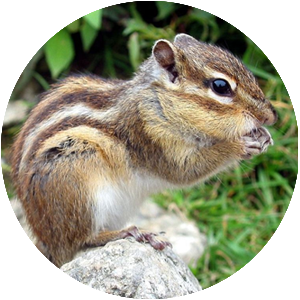
Chipmunk
AnimalUnlike other rodents that are active at night, chipmunks are diurnal animals and hibernate during winter. It has a check pouch to carry acorns, and eats insects or grasses. It makes a sharp metallic sound which enables you to check the inhabitancy of it.
-
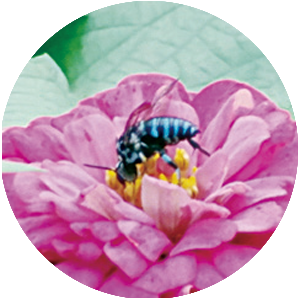
Crocisa decorus
InsectThe female body and wings are black, but some spots are lighter or darker, which create patterns. The outer part of the body is widely dark while the entire body is purple with glossy black. The black and blue short hair compactly covers the entire body, which creates patterns. It goes through stages of metamorphosis – egg, caterpillar, pupa and imago.
-
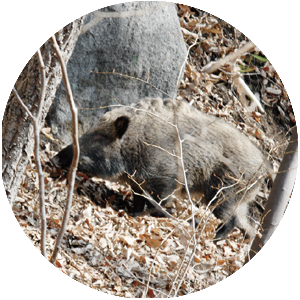
Wild boar
AnimalThe male’s bottom fangs are pointed upward. Although it is omnivore, it mainly feeds on plants such as acorns, chestnuts, and arrowroots. Its sense of smell is well developed; it digs up dirt using a long snout to eat roots of plants. It scratches an evergreen’s trunk with its fangs until resin comes out, and it rubs its body onto the resin after a mud bath. It cuts down northern bamboos to build a shelter or a nest for nursery.
-
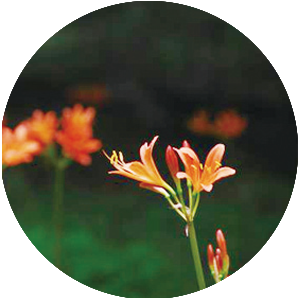
Lycoris koreana NAKAI
PlantIt is a perennial plant that grows in mountainous areas. Bulb is oval shaped and has dark brown shell. The leaves are 30 to 40 cm long. The flower stem comes out after the leaves fade. In September, 4 to 6 red-brick colored flowers bloom, on the tip of a peduncle. It has 6 tepals. The leaves are linear oblanceolate, 4.5 to 5.2cm long, and have ridges on the back.
-
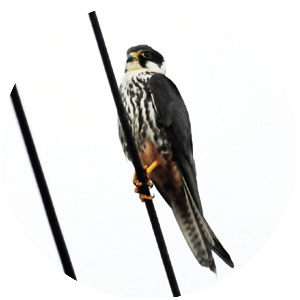
Hobby
BirdIt is a summer migratory bird. It is 33.5 to 35 cm long. The upper part of the body is dark brown and the lower abdomen and tail covert are red. There are black stripes on the chest and the abdomen. Its wings are thin and long when it flies, and have densely packed stripes on the underside. It lives in forests of open area, farmlands, and urban parks, and uses empty nests of magpies or other birds of prey as a breeding place.
-
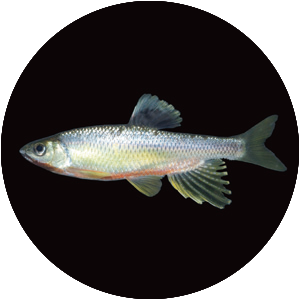
Korean dark chub
FishIt is an endemic species of the Korean Peninsula; it is usually found in the West Sea, Namhae and a river that starts from Maeupchu and flows to the East Sea. It is 10 to 15 cm long. It usually lives in clean stagnant water, in the upper and mid sections of the stream, however it sometimes makes its way to the rapid stream. It usually eats aquatic insects or insects that fall on water. The spawning season is estimated to be from June to August.
-
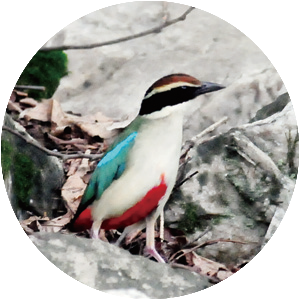
Fairy pitta
BirdA summer migratory bird that lives in the copes and broad-leaved forests near the coastal or in island. It walks on the ground to forage. The top of the head of male and female is brown and has a black centerline. The eye coverts are golden brown with hint of cream color, and they are expended to the back of neck.
-
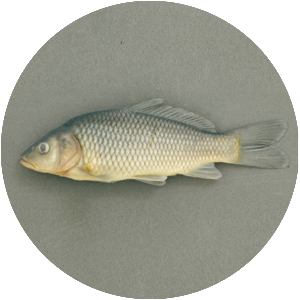
Minnow
FishIt is about 15cm long and flat. The upper jaw protrudes the lower jaw. The body is dark blue, dark on the back and light on the belly. There are 10 to 13 dark blue lateral strips on the side of the body. The male’s stripes are red. They flock in the mid-section of the river and are omnivorous. It spawns from May to August. The males form sphere of influence to protect their eggs.
-
Source by
National Institute of Biological Resources
(https://species.nibr.go.kr)Korea National Arboretum
(https://www.nature.go.kr)
A Bio-resource Survey
ㅡ
Biological Distribution Range
Naejangsan, Maeul soop-gil, arboretum, Yeongwol wetland, wolbong wetland
Remark
There are 2 Wolyeong wetlands which are designated by the Ministry of Environment, between Solti town and Wolyeong town. There are colonies of Naejangsan natural monument (No.911) with Daphniphyllum macropodum Miq. and Torreya nucifera. It is a perfect place for otters, because there are Naejang reservoir and the waterways or streams are connected to village.
-
Korean maple
PlantIt is a deciduous arbor that grows in the mountains in Korea, and is also found in Northeastern China and Russia. The stalk is 10 to 20 cm. The leaves grow in opposite leaf arrangement, and their width and length are about 10cm. The bottom of the leaf is the shape of a heart. The back of the leaf has a lot of white hair. Both maple syrup in Western countries and golisoo in Korea are the sap of this sweet maple tree. The maple seed resembles a propeller, which spins round when the wind blows.
-
Leopard Cat
AnimalBecause a leopard cat lives on rats, it has a long body and short legs. It also eats fruits like mulberries and Siberian gooseberries, as well as insects in summer. It is active day and night. The male is twice as large as the female. Just like other Mustelidae family, it defecates long and thin feces on a rock,
-
Lycoris chinensis var. sinuolata (Jinnorang sangsahwa)
PlantIt is a perennial plant that grows in clusters near a humid valley of low mountains. The green linear-shaped leaves, which are about 32.2 to 50 cm long and 1.2 to 2.5 cm wide, grow from April to May as overlapping with 3-4 leaves. A Buddhist monk fell in love with a woman who came to a temple to worship. However, he was not allow to date with the woman because he was a monk. Then he died of a lovesick. The flower bloomed on his grave resembled the monk, as the leaf withered before the flower bloom – they never grow (or meet) at the same time; so people have called this flower as Sangsahwa (roughly translating to ‘longing for someone’ in Korean).
-
Thlaspida cribrosa
InsectThe body is 8.2 mm long and the head is 1.3 mm wide. Its reddish-brown body is flat and long oval-shaped. There are 16 pairs of bumps on a side which are covered with bristles and 1 pair of anal papilla. The spiracle and the sides of the body are dark brown. It has a unique features. The caterpillar covers itself with a cast-off skin and feces to camouflage by making itself as a big chunk. When it feels threats, it doesn’t move and pretends it is dead.
-
Daphniphyllum macropodum Miq.
PlantIt was originally found in the southern part of Korea; however, with the change of climate, it is also found in Mt. Naejang (Natural Monument No. 91), which is placed in northern limit line (NLL), as it moves its habitat towards the norther part. This species is also called gyoyangmok (written in Chinese characters) as well as in China and Japan. When the new leaves grow, the old leaves fall off, so that the new leaves can grow well.
-
Naejangsan-ddee-dalpengi
MollusckThe shell is conical shaped which is 13mm high and 19mm wide. There are 5.5 stories of whorl. The shell epidermis is light yellow; the colors may vary depending on the distribution. Spirals are brown and incremental lines are very clear. The suture is definite. Shell lip is a semicircle that is rolled out. The respiratory pore is small and not really deeply placed; some part is covered with outer lip. Inside of shell lip is white.
-
Chipmunk
AnimalUnlike other rodents that are active at night, chipmunks are diurnal animals and hibernate during winter. It has a check pouch to carry acorns, and eats insects or grasses. It makes a sharp metallic sound which enables you to check the inhabitancy of it.
-
Crocisa decorus
InsectThe female body and wings are black, but some spots are lighter or darker, which create patterns. The outer part of the body is widely dark while the entire body is purple with glossy black. The black and blue short hair compactly covers the entire body, which creates patterns. It goes through stages of metamorphosis – egg, caterpillar, pupa and imago.
-
Wild boar
AnimalThe male’s bottom fangs are pointed upward. Although it is omnivore, it mainly feeds on plants such as acorns, chestnuts, and arrowroots. Its sense of smell is well developed; it digs up dirt using a long snout to eat roots of plants. It scratches an evergreen’s trunk with its fangs until resin comes out, and it rubs its body onto the resin after a mud bath. It cuts down northern bamboos to build a shelter or a nest for nursery.
-
Lycoris koreana NAKAI
PlantIt is a perennial plant that grows in mountainous areas. Bulb is oval shaped and has dark brown shell. The leaves are 30 to 40 cm long. The flower stem comes out after the leaves fade. In September, 4 to 6 red-brick colored flowers bloom, on the tip of a peduncle. It has 6 tepals. The leaves are linear oblanceolate, 4.5 to 5.2cm long, and have ridges on the back.
-
Hobby
BirdIt is a summer migratory bird. It is 33.5 to 35 cm long. The upper part of the body is dark brown and the lower abdomen and tail covert are red. There are black stripes on the chest and the abdomen. Its wings are thin and long when it flies, and have densely packed stripes on the underside. It lives in forests of open area, farmlands, and urban parks, and uses empty nests of magpies or other birds of prey as a breeding place.
-
Korean dark chub
FishIt is an endemic species of the Korean Peninsula; it is usually found in the West Sea, Namhae and a river that starts from Maeupchu and flows to the East Sea. It is 10 to 15 cm long. It usually lives in clean stagnant water, in the upper and mid sections of the stream, however it sometimes makes its way to the rapid stream. It usually eats aquatic insects or insects that fall on water. The spawning season is estimated to be from June to August.
-
Fairy pitta
BirdA summer migratory bird that lives in the copes and broad-leaved forests near the coastal or in island. It walks on the ground to forage. The top of the head of male and female is brown and has a black centerline. The eye coverts are golden brown with hint of cream color, and they are expended to the back of neck.
-
Minnow
FishIt is about 15cm long and flat. The upper jaw protrudes the lower jaw. The body is dark blue, dark on the back and light on the belly. There are 10 to 13 dark blue lateral strips on the side of the body. The male’s stripes are red. They flock in the mid-section of the river and are omnivorous. It spawns from May to August. The males form sphere of influence to protect their eggs.
Source by
National Institute of Biological Resources (https://species.nibr.go.kr)
Korea National Arboretum (https://www.nature.go.kr)